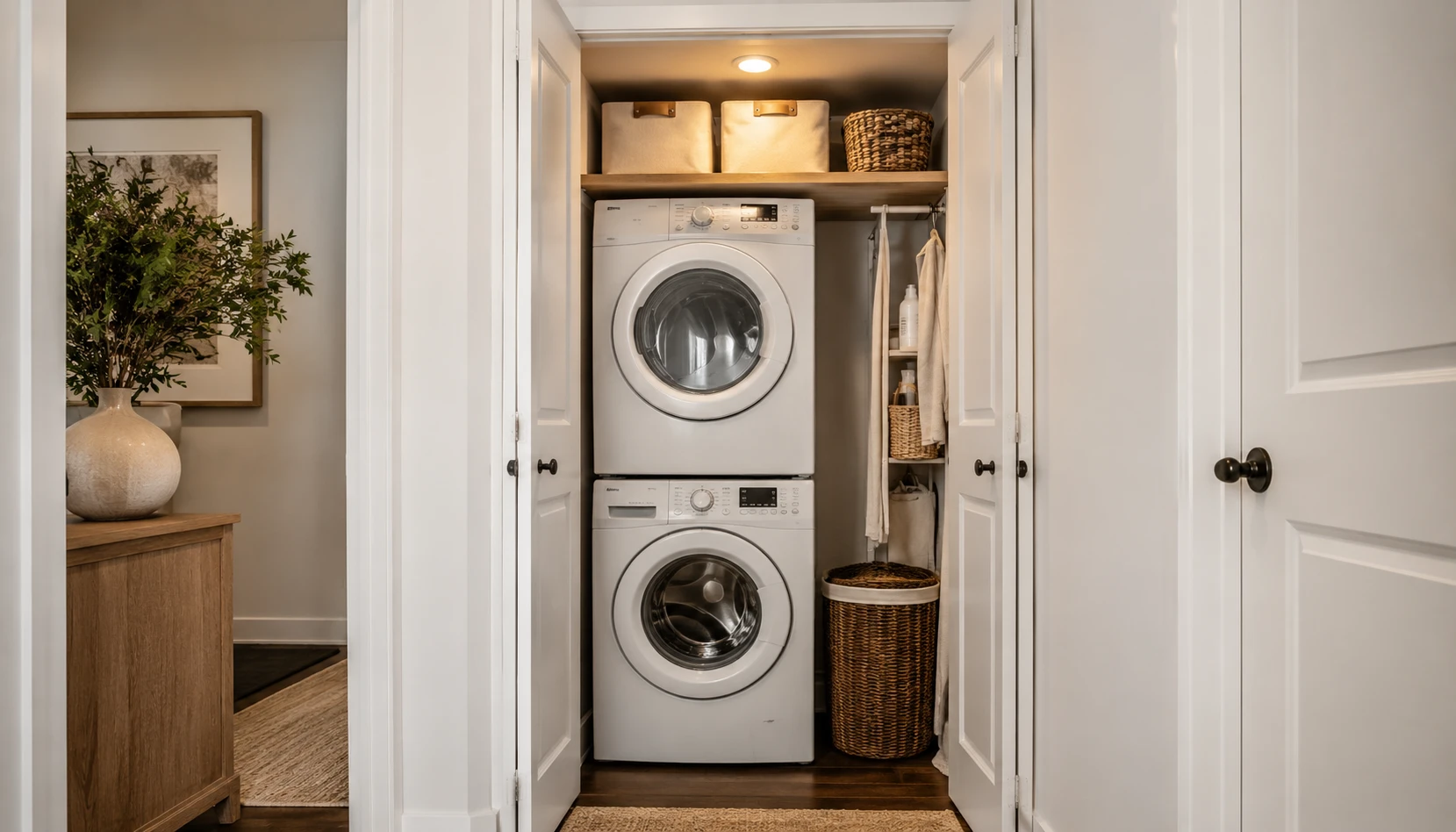
Many laundry room guides assume you have four walls, a door, and perhaps a window. A stacked washer and dryer behind bifold hallway doors creates a different problem: the area has almost no floor space, limited ventilation, and nowhere obvious to fold clothes or organize supplies.
A closet has a different set of problems than a room. There’s no floor space to wheel in a cart. The doors themselves get in the way half the time. And unless you got lucky with your building’s layout, there’s probably no window and no real vent fan, which changes the lighting plan and the moisture plan both.
None of that means the closet has to stay an eyesore. It just means the fixes have to be sized for a closet, not borrowed wholesale from a laundry room that has three times the space to work with.
Why a Laundry Closet Is Different
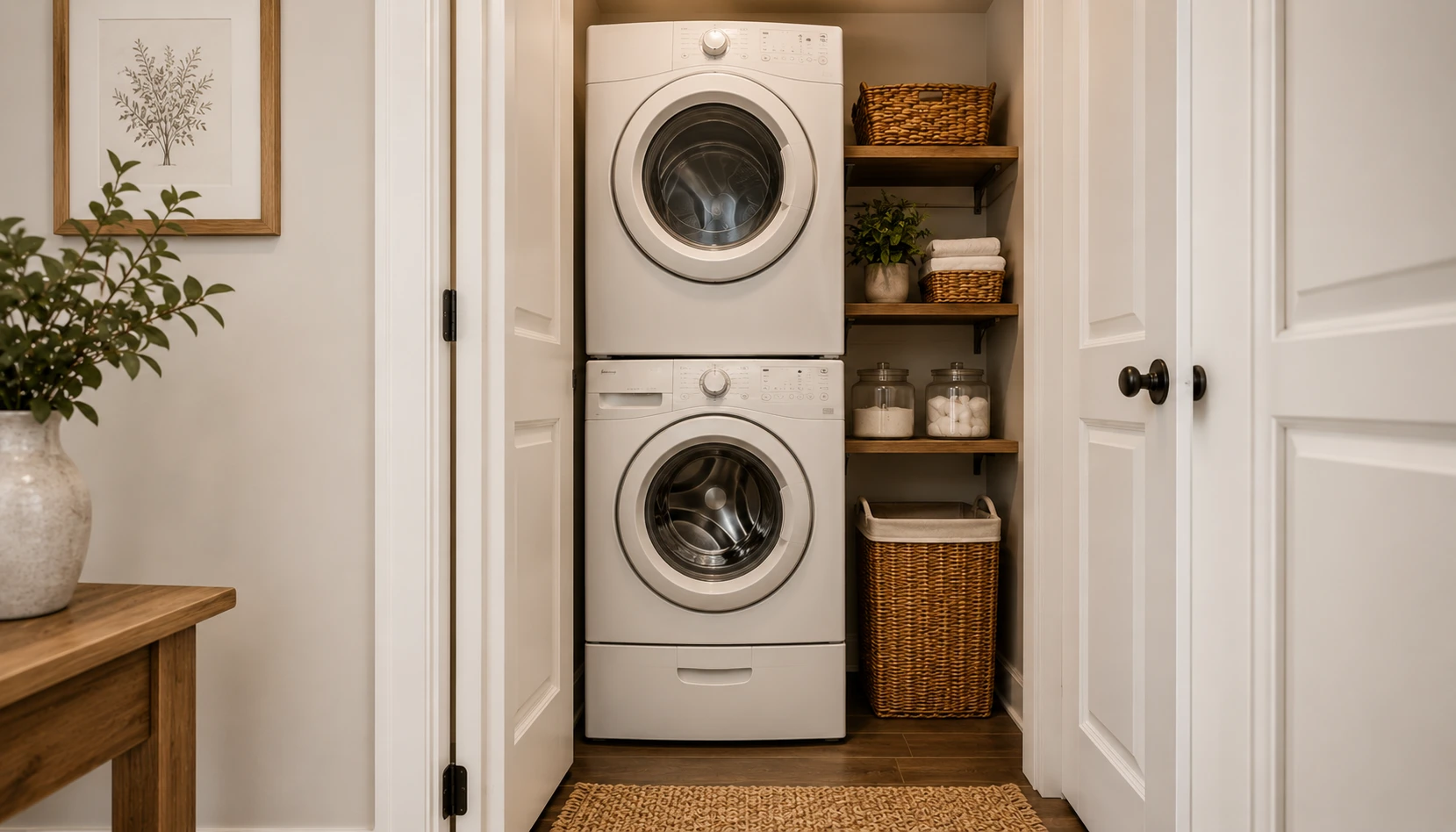
There’s no floor space to add furniture, full stop. A laundry room can fit a folding table or a rolling cart with a laundry basket underneath. A closet can’t, so every storage idea in this guide has to mount to a wall or wedge into the gaps around the machines.
The doors are part of the problem, not just the entrance. Bifold or sliding doors eat their own swing space, and they tend to block exactly the spot where you’d want to fold a shirt or reach a shelf. Mine used to hit my elbow every single time I reached for the dryer sheets. That’s what finally got me to fix the layout.
Natural light and venting are rare in this setup too. Most laundry closets have neither, which changes both the lighting plan and how seriously you take moisture. And because you’re usually standing in one fixed spot reaching in every direction, rather than walking a full circle around the machines the way you can in a room, reach matters more here than almost anywhere else in the house.
It still needs to look like somebody lives there. A closet gets opened just as often as a laundry room door does. I’d argue it deserves the same five minutes of thought a bathroom cabinet gets, even though almost nobody gives it that.
Every idea below is built around these constraints specifically, rather than shrinking full laundry room advice down until it barely fits.
Stackable Washer and Dryer Basics
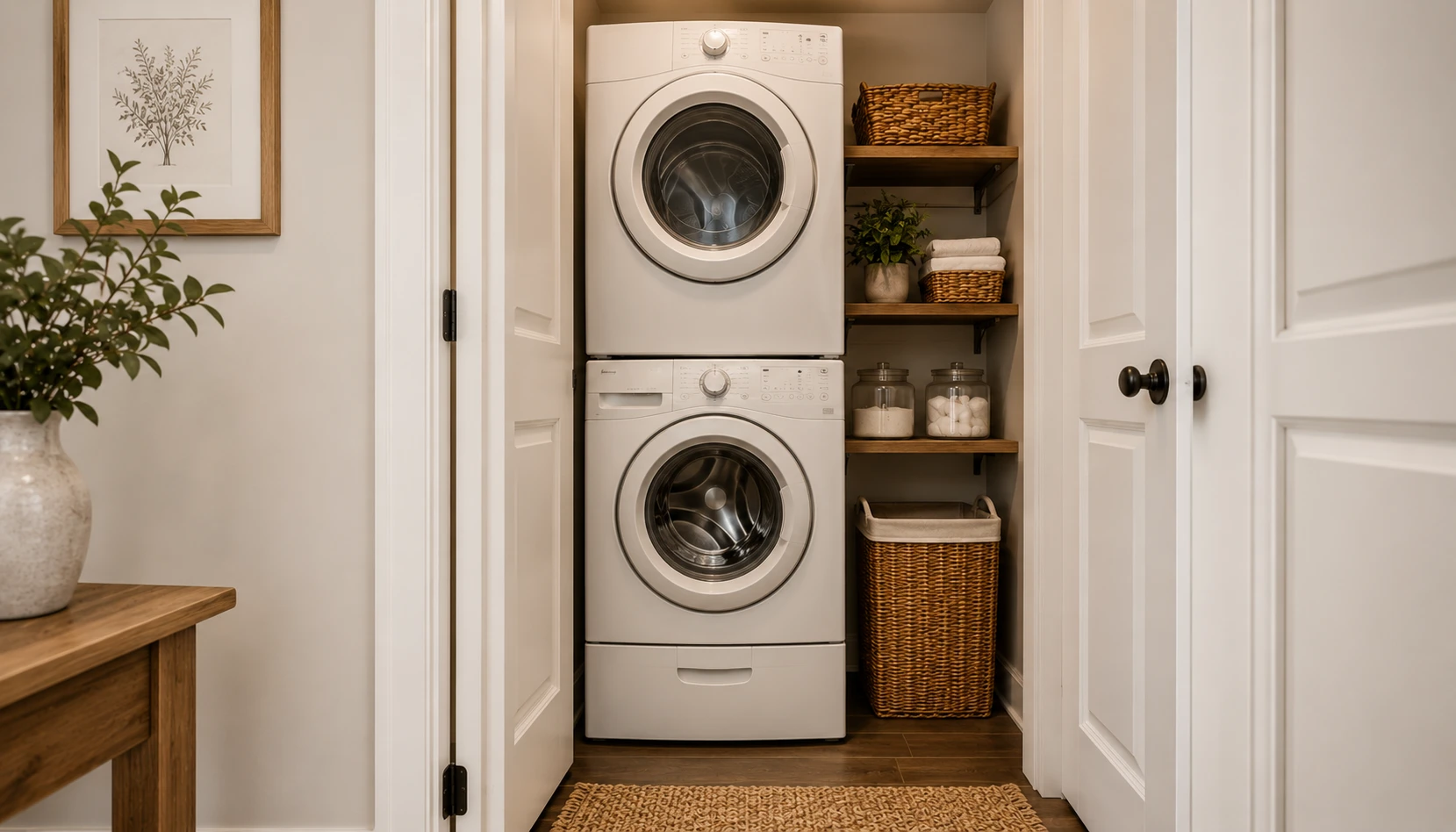
Get the machine setup right first. Everything else in this guide depends on it.
Confirm your washer and dryer are actually rated to stack together, not just physically capable of it. Some pairs need a specific stacking kit rated for that exact model combination, and skipping this step is how people end up with a dryer that vibrates its way three inches to the left over a year of use.
A pedestal drawer can be worth the extra cost if your ceiling height allows it. It raises the front-load door to a height that requires less crouching, and the drawer itself holds detergent pods or dryer sheets in space that would otherwise sit completely empty. Measure the full appliance, pedestal, connection, and clearance height before buying one.
Leave a couple of inches of clearance on the sides if you can. Even a narrow gap is enough for a slim pull-out organizer, and it helps airflow around machines that already run hotter in an enclosed closet than they would in a ventilated room. Check the door swing too, on both the closet doors and the machine doors themselves, before you finalize anything. A front-load washer with a door that swings straight into your closet doors is a genuinely annoying daily problem that’s completely avoidable if you check first.
If your stacking kit comes with a built-in shelf option, take it. That’s free vertical storage sitting right at eye level, and there’s no real reason to skip it.
Vertical Storage Solutions
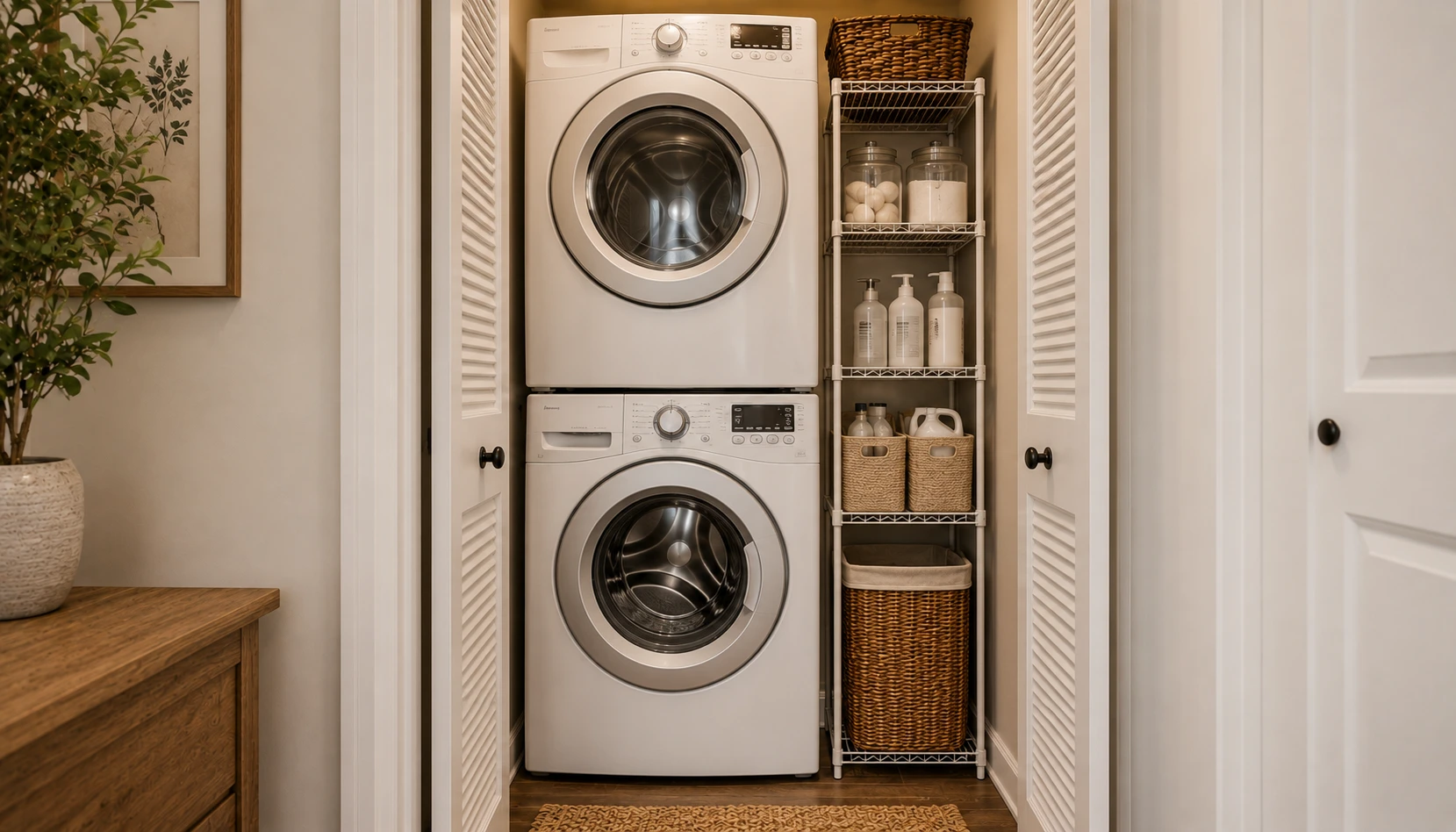
Vertical space above and beside the machines is the only real storage opportunity you have here, and it’s more generous than it looks once you actually measure it.
One well-placed floating shelf can beat three cluttered ones. A single 12-inch shelf above the machines holds detergent, dryer sheets, and a small basket without turning the closet into visual noise. Additional shelves only help when their contents and required clearances have been planned in advance; otherwise, they create more surfaces to keep tidy without adding much usable storage.
If you’ve got four to six inches of clearance on either side of the machines, a narrow wire tower fits there and holds the overflow bottles that don’t fit on the main shelf. A pegboard on the back wall, if the closet is deep enough, is genuinely underrated. Mine holds a small hand broom and a hanging basket, using zero floor space and zero shelf space.
Baskets over loose bottles, every time. A basket on an open shelf reads as intentional. Loose bottles read as clutter, and that’s true in the exact same square footage. It’s a small swap that changes how the whole thing looks.
One spot people forget entirely: the shelf directly above the door frame. It’s awkward to reach daily, which makes it perfect for the stuff you only need twice a year, like a spare filter or the extra dryer vent brush.
Hiding the Closet Behind Doors
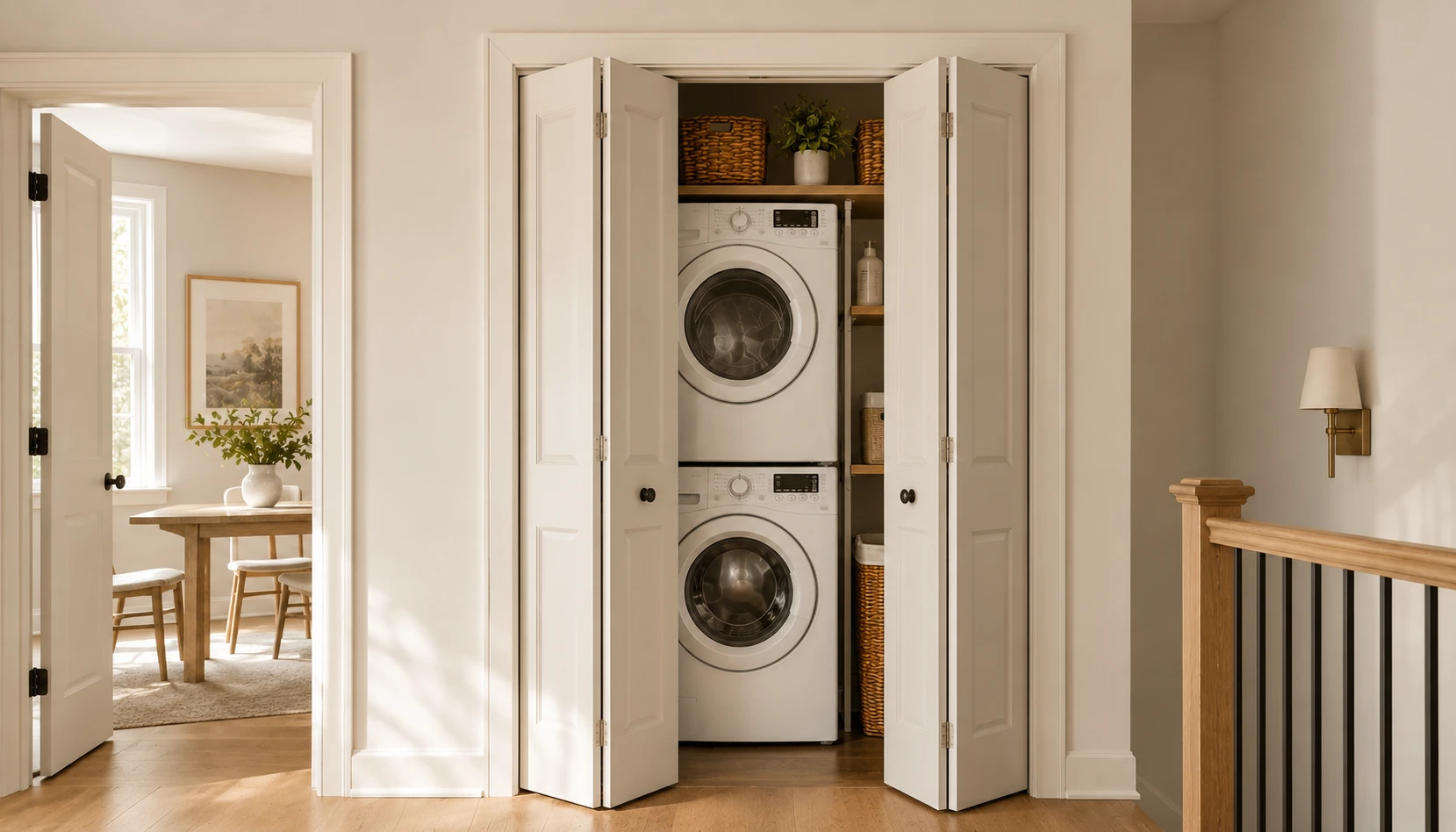
Unlike a laundry room door tucked out of sight, closet doors sit in a hallway or living space where you see them constantly, open or closed.
Paint them to match the wall around them. That’s the single easiest way to make a laundry closet disappear when it’s closed instead of standing out as an obvious utility door in an otherwise finished hallway. If your doors are dated bifolds you don’t love, a floor-length curtain on a tension rod is a real option, and it’s about as renter-friendly as a swap gets since you can take it down in thirty seconds without a landlord noticing.
Use the back of the door itself. A small hook holds a lint roller or a spray bottle, and it’s space you’re otherwise wasting completely. If your bifold track sticks or drags, fix it. It’s almost always a five-minute adjustment, not a real repair, and a sticking door is one of those small annoyances that somehow never gets fixed for years.
Match the hardware to the rest of the hallway rather than whatever mismatched builder-grade pull came with the house. It’s a tiny detail. It also happens to be the kind of detail that separates a closet that looks planned from one that looks like nobody’s touched it since move-in.
Lighting for a Windowless Closet
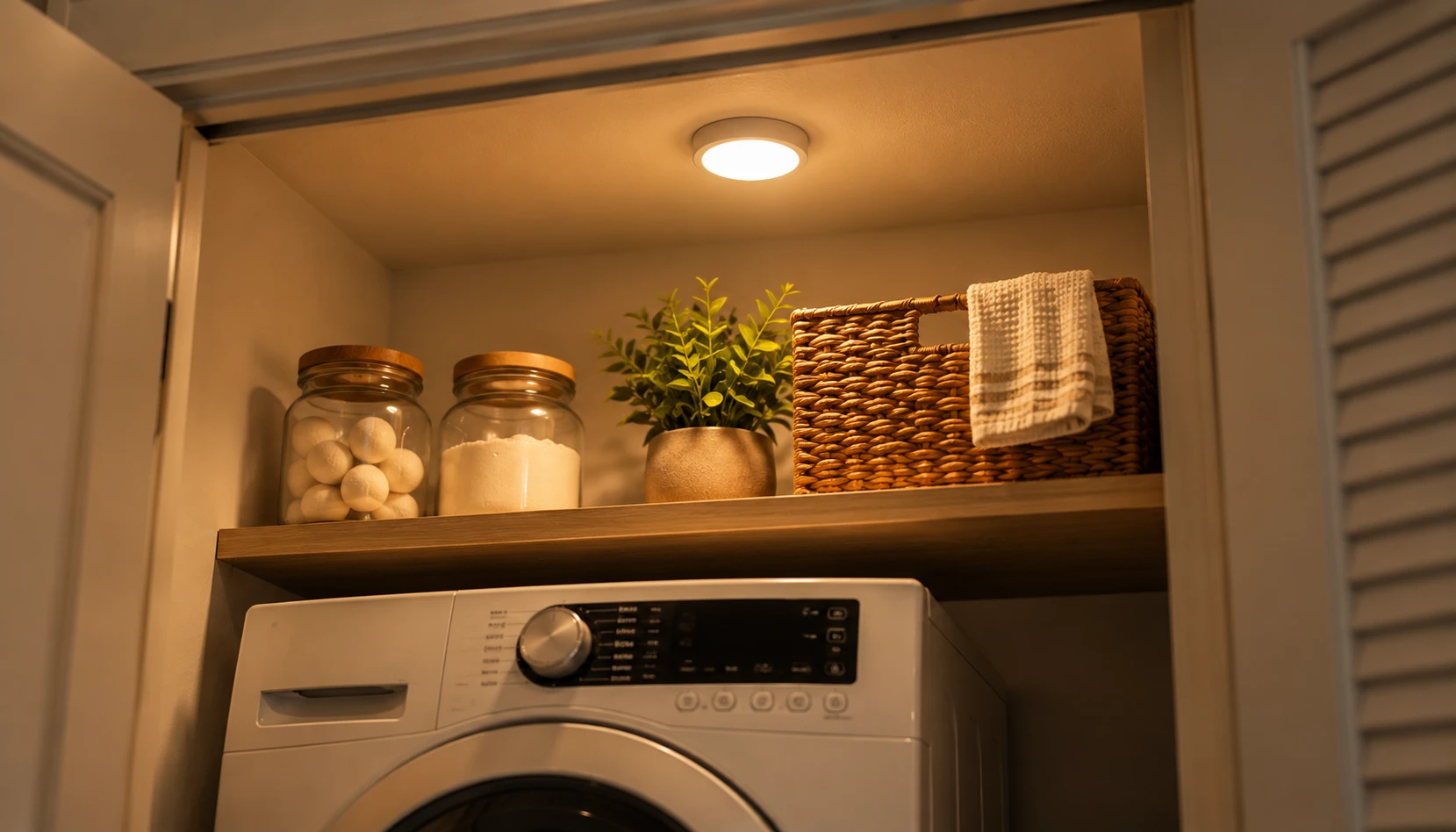
Most closets have no dedicated fixture at all. You get whatever spills in from the hallway, which is usually not enough to check a pocket for a tissue before it shreds across a whole load.
A battery-operated or plug-in puck light fixes this without any electrical work, and they run about $15 to $20 for a decent one. It’s the single cheapest, most noticeable fix in this entire guide. Get one in a warm color temperature, 2700K to 3000K, not the stark blue-white ones meant for a garage. A warm bulb makes the closet feel like part of the home instead of a utility afterthought bolted on.
If the closet gets brief, infrequent use, a motion-activated version saves you from ever fumbling for a switch. And if you’re doing real electrical work and adding a proper fixture, center it overhead rather than off to one side, so it doesn’t throw a shadow across the machines or the shelf below.
Keep the fixture itself slim. In a tight closet, even an inch of clearance matters, so a flush-mount or puck light beats anything that hangs down and eats into your already limited headroom.
Folding Surface Solutions
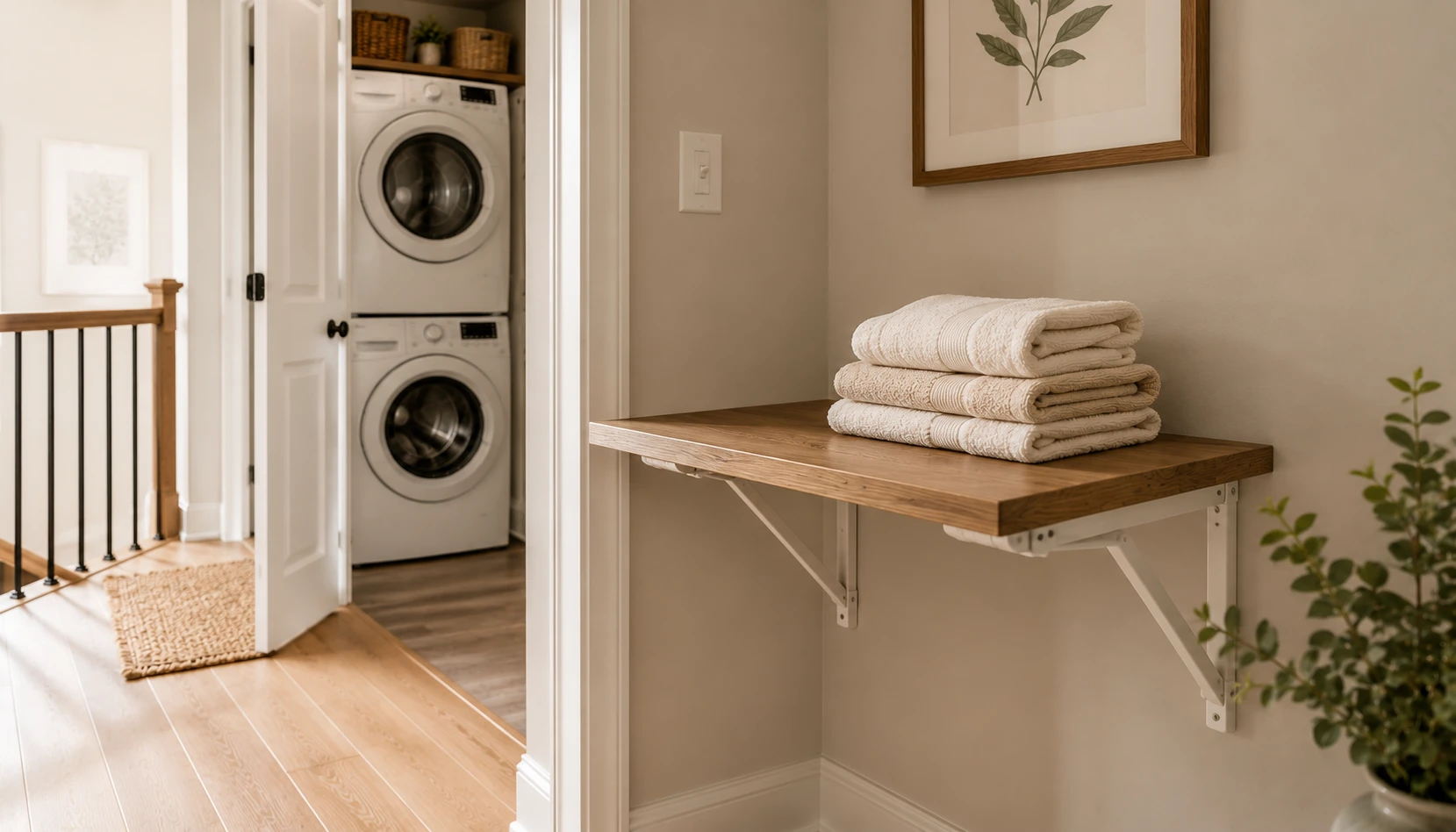
This is the hardest problem in the whole guide, honestly. A laundry room has a countertop or a nearby table. A closet usually has neither, and I don’t think there’s a perfect fix, just a few reasonable ones depending on what you’re willing to install.
A fold-down counter mounted just outside the closet opening is the closest thing to a real solution. It folds flat against the wall when you’re not using it, so it doesn’t permanently eat hallway space. If that’s more than you want to commit to, a slim silicone mat on top of the dryer works for one load at a time, and it protects the finish while you’re at it. Some laundry organization systems include a narrow pull-out shelf designed to tuck into gaps as small as a few inches, which is worth checking before you assume nothing fits.
Honestly, the easiest answer for a lot of people is just accepting that the folding happens somewhere else entirely, a nearby console table, the bed in the next room, and letting the closet handle only the washing and drying. There’s no rule that says the closet has to do everything. A rollable folding mat that lives on a shelf and unrolls onto whatever flat surface is nearby covers the gap for almost no money.
Hanging and Drying Space
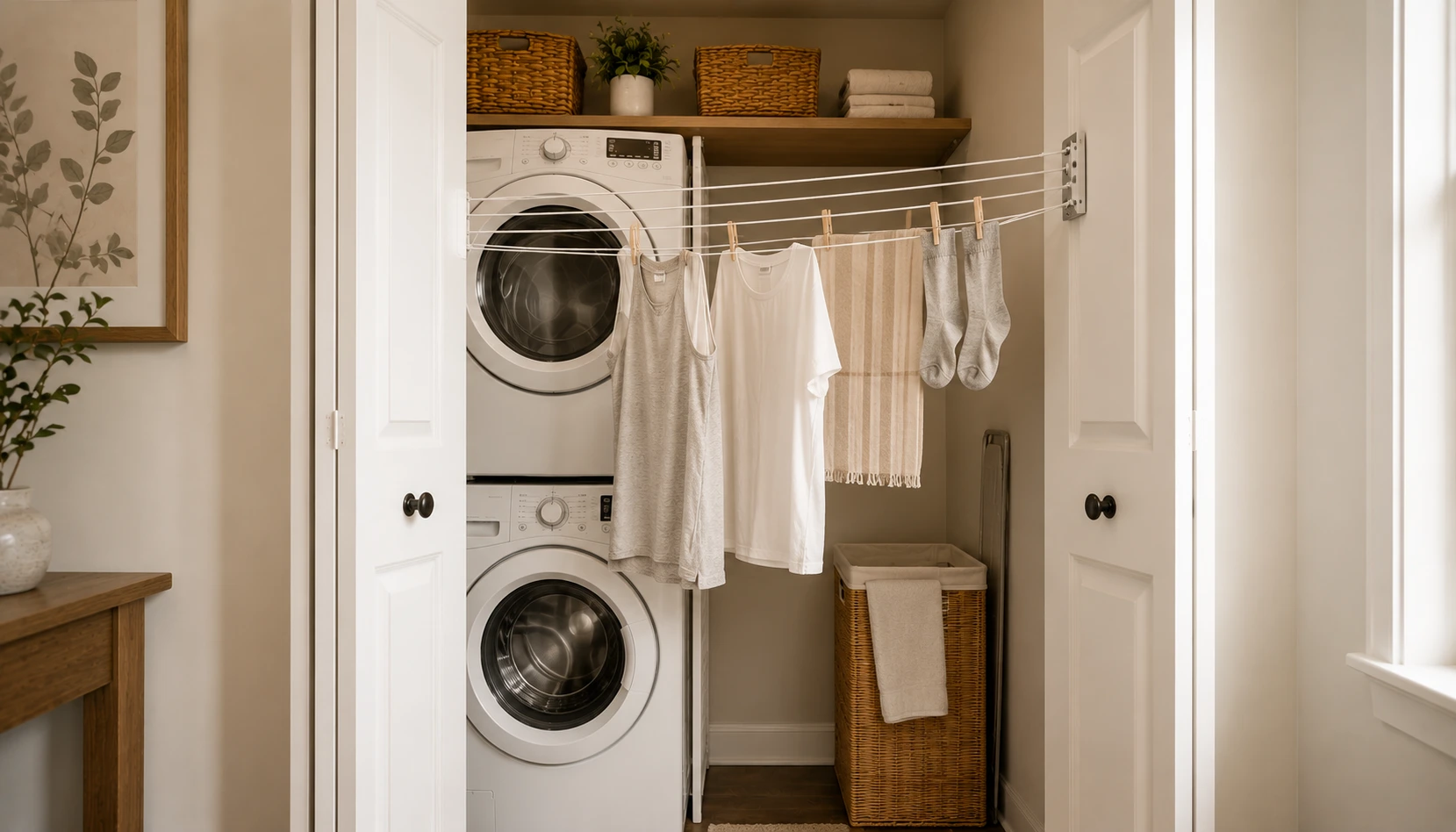
Delicates and air-dry-only garments need somewhere to hang, and most closets have no room for a standing rack.
A retractable clothesline is the best answer here specifically, not just a decent one. It disappears completely between loads instead of permanently occupying space the way a folding rack would. A short hanging rod above the machines works too, even a foot or two of it, enough to hang a shirt straight out of the dryer before it wrinkles into a mess you’ll iron later and complain about.
If you’re renting and don’t want to commit to anything permanent, a tension rod across the closet opening costs about $10 and comes down just as fast. An over-the-door rack on the inside of the door uses space that otherwise does nothing at all, though whatever you choose, double-check it clears the door’s swing path. I hung a rack once that caught the door mid-close every time. Took me two weeks to notice why the door wouldn’t shut all the way.
Color and Material in a Tight Space
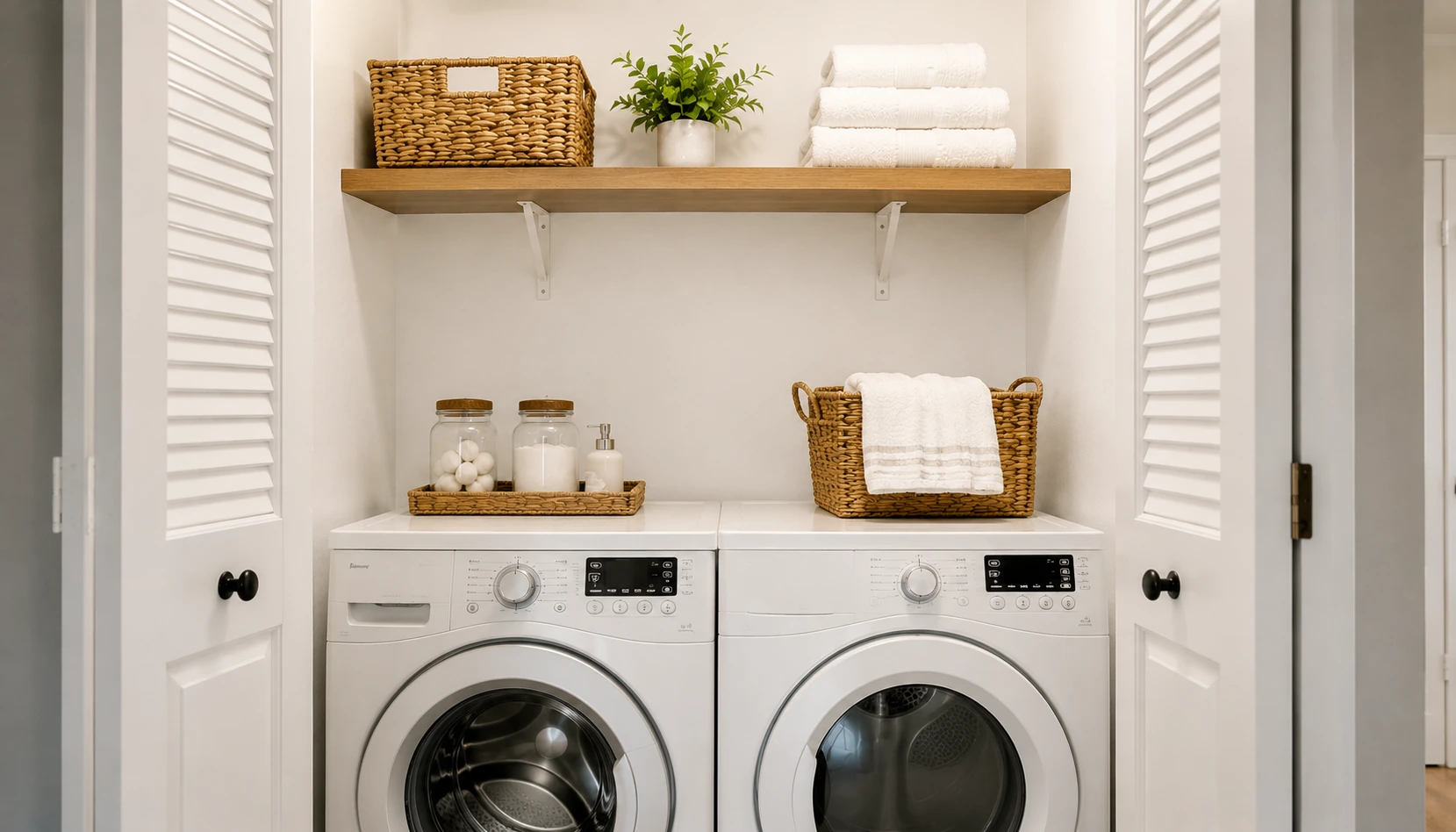
The same logic that helps a small bathroom feel considered instead of cramped applies here too, almost word for word.
Paint the interior something soft, light, and reflective. A closet this dim needs every bit of light bounced back that it can get, whether that light comes from a puck light or just the hallway. One warm material touch goes a long way against all that white. A wood shelf or a woven basket keeps it from reading as purely clinical, and it costs almost nothing to add.
Keep visible hardware in one metal finish. Shelf brackets, hooks, any door hardware, all matching, or the space starts to feel busier than its size actually justifies. Because this closet deals with lint and the occasional spill, a satin or semi-gloss paint holds up better than flat, and it’s worth the marginal cost difference at the store. Skip a bold pattern or a dark color on the back wall. In a space this tight and this dim, that choice makes the room feel smaller, not more finished, the exact opposite of what you’re going for.
Organizing Supplies Without a Pantry
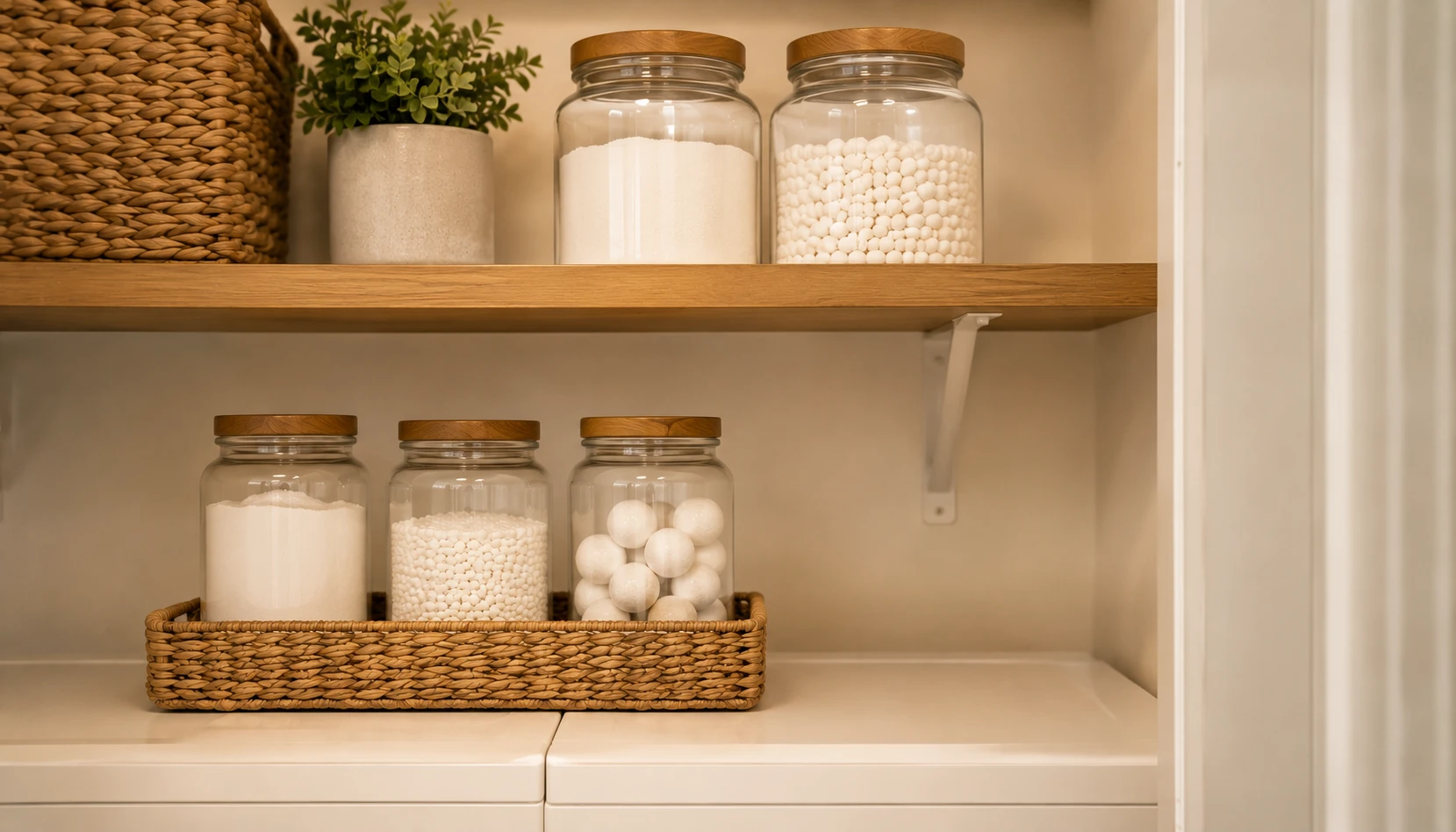
A lot of laundry guides assume a nearby pantry or mudroom for overflow. If your setup is a true closet, there usually isn’t one.
Decant detergent into something smaller. A bulk jug rarely fits the scale of a closet shelf, and a refillable pump dispenser takes a fraction of the space while looking considerably more finished sitting out. I know buying smaller quantities more often costs a bit more per ounce. I still think it’s worth it here, because there’s genuinely nowhere to store the savings from buying in bulk.
One divided caddy that groups detergent, stain remover, and dryer sheets together stays tidy far longer than the same three items loose on a shelf. Anything you don’t use weekly, seasonal linens, backup filters, belongs somewhere else in the house entirely. And if more than one person uses this closet, label things. It sounds fussy until you’ve watched an organized shelf slide back into chaos within three weeks because nobody knew where the stain stick went.
Ventilation and Practical Considerations
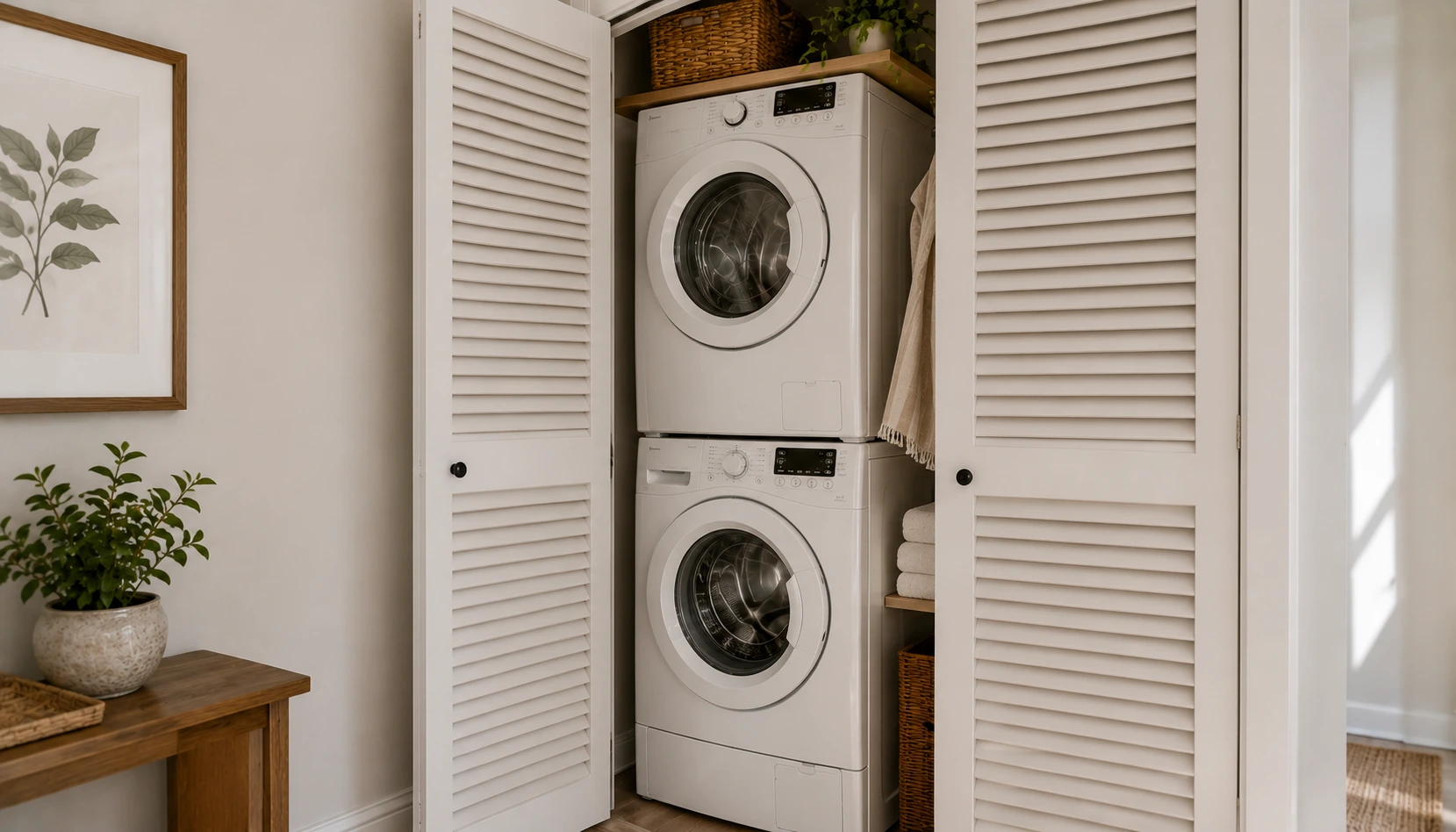
A few points here aren’t about how anything looks, but they matter enough that skipping them undoes the rest of this guide.
Check your dryer vent path before you add any shelving nearby. It’s tempting to tuck a basket right up against the vent hose to steal an extra inch of space, and it’s also exactly how you end up with restricted airflow, which is a real safety issue, not just a performance one. If you’re replacing the original doors, louvered or slatted ones let air move around the machines in a way solid doors don’t, which matters in a closet that traps heat and moisture with the doors shut most of the day.
Leave the clearance behind the machines that the manufacturer specifies. I get the temptation to push everything flush against the back wall for one more inch of shelf space. That clearance exists for a reason, and it’s not a suggestion. If there’s a musty smell that won’t go away, deal with the actual cause rather than masking it with an air freshener clipped to a vent. Nine times out of ten it’s a moisture or ventilation issue, and it gets worse, not better, if you ignore it.
Styling Touches That Still Work
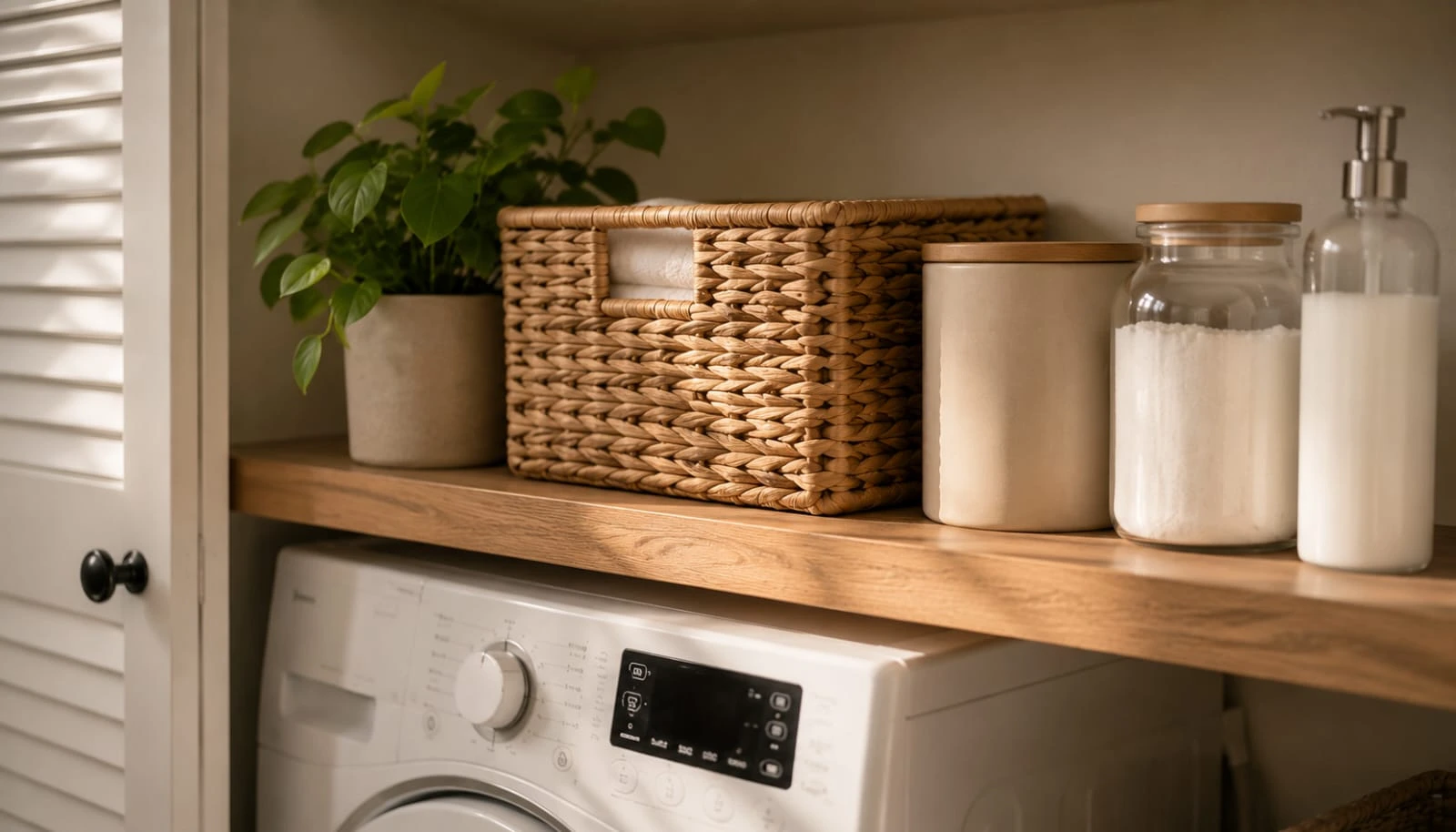
Even a genuinely tiny laundry closet deserves the same finishing instinct as every other room in the house.
If the closet gets any indirect light at all, a small plant helps. A pothos cutting in a jar tolerates low light fine and adds a bit of life to a space that’s otherwise pure function. One coordinated set of storage containers, instead of whatever mismatched bottles and boxes accumulated over the years, does more for how “done” the space looks than almost anything else on this list. It’s a small purchase with an outsized visual payoff.
A little personality helps too. I keep a small printed label set on the inside of my door, nothing fancy, and it makes opening the closet a slightly better daily moment than it used to be. Same with a small scent sachet tucked onto a shelf. It’s a tiny thing. It’s also one of those tiny things that actually changes how a space feels to use every day.
Don’t overdo it, though. The same restraint that works in a small bathroom applies here. A few well-chosen touches read as styled. Too many small decorative objects crammed into a genuinely small closet just reads as clutter with better lighting.
Common Laundry Closet Mistakes
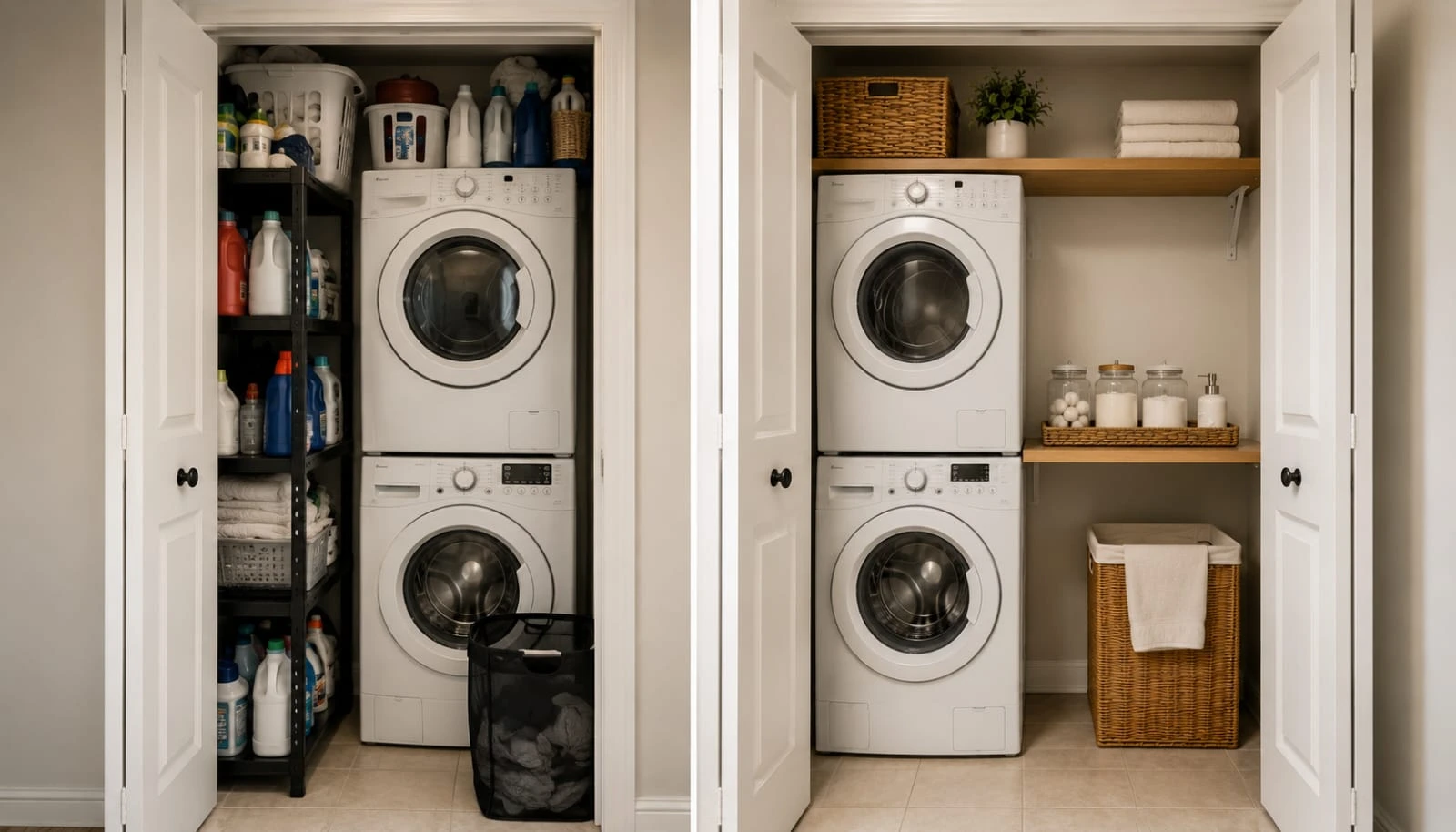
A handful of mistakes show up again and again in laundry closet projects, and most of them are avoidable if you catch them early.
Buying storage built for a full laundry room is the big one. A standing cart or shelf unit that assumes floor space just won’t fit, and forcing it in usually ends up blocking the door swing instead. Along the same lines, adding shelving or a hanging rack without first checking how the doors actually open is one of the easiest mistakes to make and one of the easiest to avoid, if you just check first.
Skipping lighting because there’s no existing fixture leaves the single most common complaint about these closets completely unsolved, and it’s a fifteen-dollar fix. Buying detergent in bulk with nowhere to put the overflow just relocates the clutter instead of solving it. Squeezing extra shelving in behind a dryer vent creates a real airflow problem, not a styling inconvenience. Leaving mismatched utility-colored doors means the closet stands out every time it’s shut, undoing whatever work went into the inside. And treating the whole space as purely functional, with zero styling at all, still reads as an afterthought even when everything inside is perfectly organized.
A laundry closet will never have the flexibility of a full laundry room, and I don’t think it needs to pretend otherwise. Start with the lighting and the door swing check, both cheap and both immediately noticeable, then work through storage, folding, and styling as time and budget allow.
For more small-space strategies built around the same kind of real constraint, see our guide to Room Decoration Ideas for Small Spaces and Small Bathroom Ideas, which tackles a different room with the same underlying approach.